The former industrial structures of the site—from buildings to technological infrastructure—reflect distinct phases of Romania’s industrial and technological evolution. Today, they form an anthropic landscape where built heritage and natural growth coexist in a subtle symbiosis.
This atmosphere, rich in historical industrial traces, defines the identity of the area. The project aims to preserve and reinterpret this character by integrating the site’s authentic and valuable elements. Rather than introducing foreign features, the design reveals the natural relationships that have emerged through the site’s industrial history.
The functional system of the former platform is expressed in its built structure and can be enhanced by highlighting the infrastructure network that once powered the complex. The preserved precast concrete pillars are reimagined as part of a symbolic pathway—the “cardiovascular system” of the new landscape—celebrating the site’s industrial past while connecting it to its new ecological role.
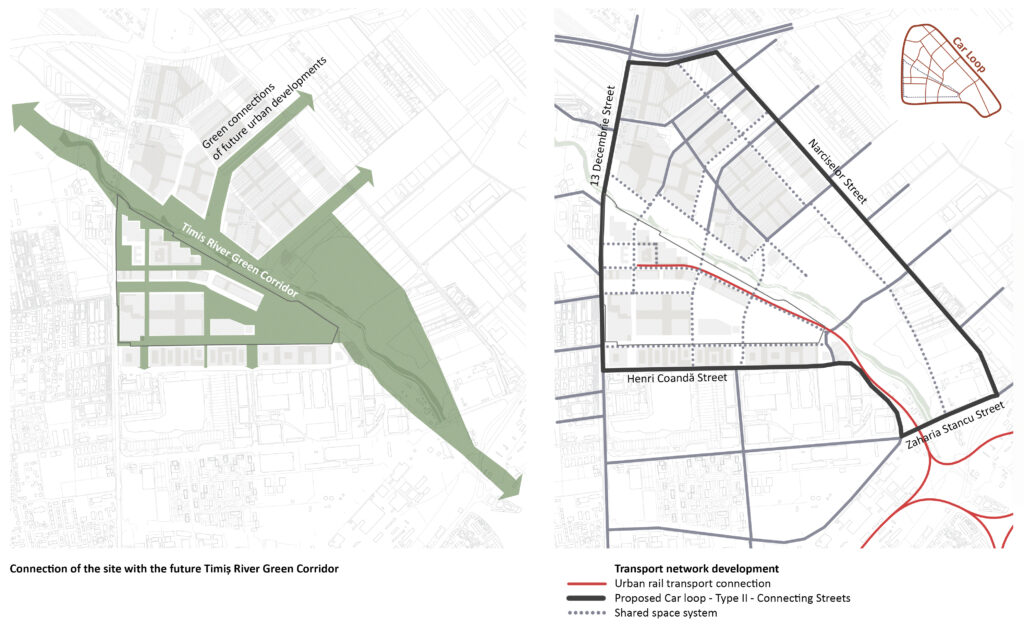
The entire redevelopment contributes to the integrated green infrastructure of the wider area. Existing and new green spaces are linked to the Timiș River corridor, creating a continuous ecological network. These connections provide habitats for local flora and fauna, support biodiversity, and reinforce the park’s function as both an urban ecosystem and a public space rooted in memory and transformation.
Studio 82 arch. Octav Silviu Olănescu arch. Anamaria Olănescu arch. Andrada Maier-Drăgan arch. Petrică Maier-Drăgan arch. Oana-Antonia Filip